Searching for the Shovel: Week 6
This week's questions come from the last 2 weeks of AGC/VT members who have been asking: What does OSHA compliance really require, and how do we know whether we are doing it right?
Q: We are a small contractor. Does VOSHA really apply to us?
A: In most cases, yes. Vermont operates an OSHA-approved state program, so VOSHA enforces workplace safety and health requirements for covered employers in the state. For most businesses, there is no general minimum employee count that makes the rules disappear. Small does not mean exempt, and “we have always done it this way” is not a compliance plan.
Q: What should we do if a VOSHA compliance officer arrives at the jobsite?
A: Stay calm, be professional, and contact the person your company has designated to manage inspections. Ask to see credentials, understand the reason and proposed scope of the visit, and identify the employer and employee representatives who will participate. Keep notes, provide accurate answers, and do not guess. If photographs or measurements are taken, document the same conditions for your own records when it is safe and appropriate. Most important, do not coach employees, obstruct the inspection, hide conditions, or retaliate against anyone who speaks with the inspector.
Q: What injury records and reports should be on our radar?
A: Many employers with more than 10 employees must maintain OSHA 300, 300A, and 301 records, although exemptions and electronic-submission rules depend on establishment size and industry. Separate from routine recordkeeping, every covered employer must promptly report certain severe events. When in doubt, call VOSHA and ask rather than letting the deadline pass.
Q: On a job with several subcontractors, isn't each company responsible only for its own people?
A: Not necessarily. On a multi-employer construction site, responsibility can extend beyond the employer whose worker is directly exposed. OSHA policy recognizes creating, exposing, correcting, and controlling employers, and more than one employer may be cited for the same hazardous condition.
Q: Is having a toolbox talk sign-in sheet enough to prove compliance?
A: A signature proves that somebody signed a sheet. It does not automatically prove that the right training occurred or that employees understood it. Good documentation identifies the topic, date, instructor, employees trained, job-specific hazards, and any demonstration or competency check required by the standard.
Q: Can we ask for help without inviting an enforcement inspection?
A: Yes. Vermont's Project WorkSAFE provides free, confidential consultation and training assistance to employers. Requesting a consultation does not itself schedule a VOSHA compliance inspection, and the visit is designed to identify hazards and help the employer correct them. There is an important catch: serious hazards found during the consultation must be corrected. That is still a far better conversation to have voluntarily than after an injury or enforcement visit.
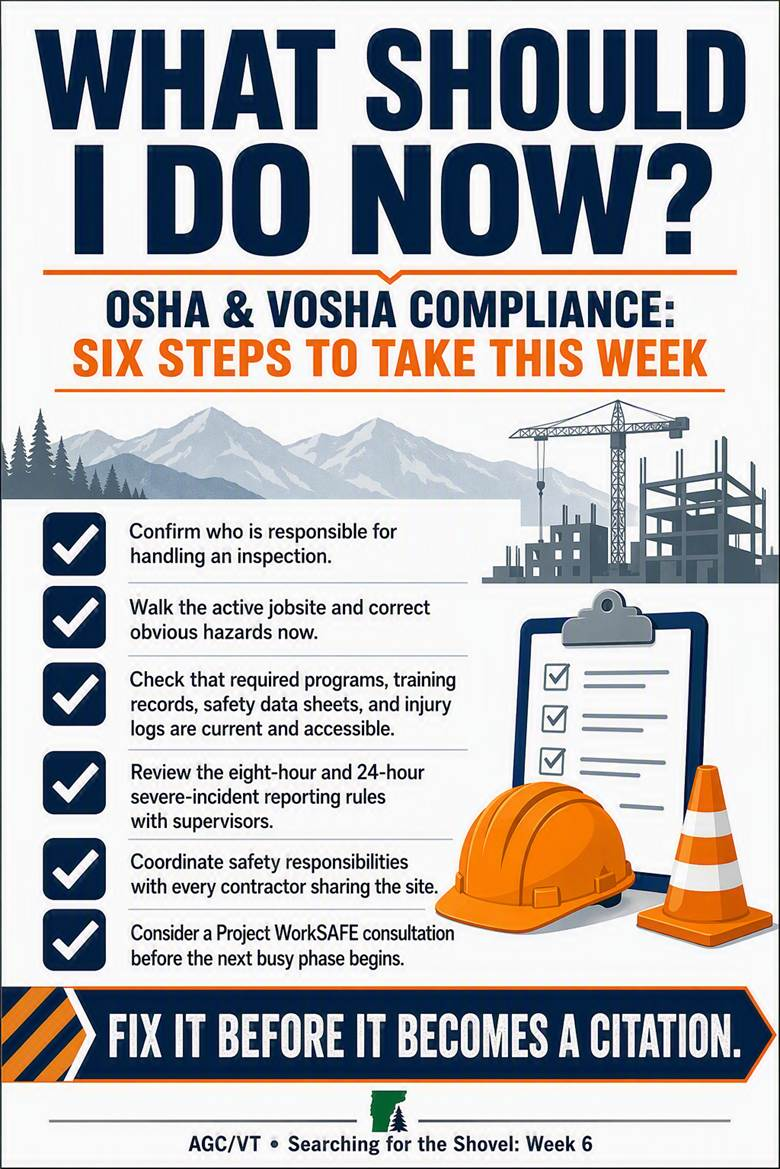
Q: What should I do now?
- Confirm who is responsible for handling an inspection.
- Walk the active jobsite and correct obvious hazards now.
- Check that required programs, training records, safety data sheets, and injury logs are current and accessible.
- Review the eight-hour and 24-hour severe-incident reporting rules with supervisors.
- Coordinate safety responsibilities with every contractor sharing the site.
- Consider a Project WorkSAFE consultation before the next busy phase begins.
 Searching for the Shovel Bottom Line
Compliance is not a stack of paperwork and it is not a magic three-ring binder. It is the everyday work of recognizing hazards, fixing them, training people clearly, documenting what matters, and following through. A contractor who can show that system in action is in a much stronger position than one who starts looking for the safety manual when an inspector pulls into the yard.
Got a question about VOSHA, OSHA logs, inspections, training, fall protection, silica, trenching, hazard communication, or another jobsite requirement? Send it our way. AGC/VT will keep translating the rules into practical steps contractors can use.
And yes, Richard is still searching for his beloved shovel, although an inspection of the tool trailer might finally turn it up.


